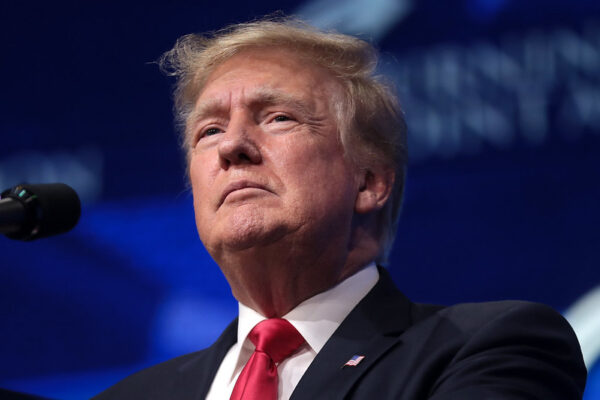
President Donald Trump said Sunday that a temporary surge in oil prices is a price worth paying if it leads to the destruction of Iran’s ability to develop a nuclear weapon, arguing that global security and peace ultimately outweigh short-term economic pain.
The president made the case in a post on Truth Social as energy markets continued reacting to the escalating conflict between the United States, Israel, and Iran during Operation Epic Fury.
Trump predicted that oil prices would fall quickly once the operation concludes and Iran’s nuclear threat has been eliminated.
“Short term oil prices, which will drop rapidly when the destruction of the Iran nuclear threat is over, is a very small price to pay for U.S.A., and World, Safety and Peace,” Trump wrote. “ONLY FOOLS WOULD THINK DIFFERENTLY! President DJT.”
His remarks come as global energy markets remain on edge. The price of Brent crude oil surged past $100 per barrel on Sunday, continuing a sharp climb that began last week after joint U.S.-Israeli strikes targeted Iran’s leadership and military infrastructure.
Those strikes killed Iranian Supreme Leader Ayatollah Ali Khamenei along with dozens of other senior figures connected to the country’s ruling theocratic regime.
Oil futures late Sunday showed barrels selling for $106.66 — a steep jump from the roughly $67 price recorded on February 27, the day before Khamenei was killed. That represents an increase of roughly 59 percent in just a matter of days, highlighting how quickly geopolitical conflict can ripple through global energy markets.
For American consumers and businesses alike, rising oil prices often translate into higher fuel costs and broader economic pressure. But Trump suggested that such concerns should be viewed through the larger lens of national and global security.
The president has framed Operation Epic Fury as a necessary step toward eliminating Iran’s nuclear ambitions, even as the conflict continues to reshape the region.
On Friday, Trump said there would be no peace agreement with Iran unless the country first agrees to what he called an “UNCONDITIONAL SURRENDER” and replaces its leadership with figures he described as “GREAT & ACCEPTABLE Leader(s).”
In remarks about the state of Iran’s military following the strikes, the president argued that the country’s capabilities have been severely weakened.
“Their army is gone, their navy is gone, their communications are gone, their leaders are gone — two sets of leaders are gone, they’re down to their third set,” Trump said. “Their air force is wiped out entirely… other than that, they’re doing very well.”
Meanwhile, Iran’s leadership has begun reorganizing in the wake of Khamenei’s death. On Sunday, Iranian officials named his son, Mojtaba Khamenei, as the country’s new supreme leader.
Trump had already dismissed that possibility earlier in the week during an interview with Axios, expressing skepticism about the younger Khamenei’s leadership.
“They are wasting their time. Khamenei’s son is a lightweight,” Trump said.
Despite the turmoil, the president has suggested the operation may be progressing faster than expected. Trump said last week that he initially estimated the strikes against Iran might take about four weeks to complete.
However, he also indicated that the U.S. and Israel appear to be ahead of that schedule.
Still, the rapid rise in oil prices illustrates how military conflict can quickly extend beyond the battlefield and into everyday economic life. Even when leaders argue the stakes involve global security, the ripple effects — from energy markets to international stability — serve as a reminder that wars often carry consequences far beyond their intended targets.
[READ MORE: Federal Judge Rules Kari Lake’s Actions at U.S. Agency for Global Media ‘Null and Void’]