Less than a week after U.S. forces carried out the dramatic capture of Venezuela’s Nicolás Maduro, Colombia’s most wanted guerrilla leader issued a striking call for unity among rival insurgent groups, urging them to set aside years of bloody infighting to confront what he described as a shared enemy: President Donald Trump and the United States.
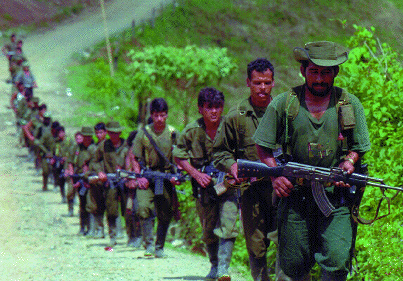
In a video circulated last week, Iván Mordisco, the leader of the largest dissident faction of the former Revolutionary Armed Forces of Colombia, appeared in military fatigues flanked by armed fighters and delivered an unmistakable message. After decades of violent conflict over territory, drug routes and illicit economies, Mordisco said the time had come to unite against what he called the looming threat of U.S. intervention.
“The shadow of the interventionist eagle looms over everyone equally,” Mordisco said, calling on rival groups to put aside their differences and form a unified insurgent bloc. Mordisco, whose real name is Néstor Gregorio Vera, singled out Colombia’s most powerful guerrilla organization, the left-wing National Liberation Army, known as the ELN.
The appeal raised eyebrows among security experts given the long and brutal conflict between Farc dissidents and the ELN, particularly along Colombia’s border with Venezuela. Jorge Mantilla, a security analyst specializing in Colombian guerrilla movements, said the proposal was notable precisely because of the immense humanitarian toll of that infighting.
“The war between Mordisco’s group and the ELN has been very, very bloody,” Mantilla said, adding that the call for unity underscored how seriously insurgents view the shifting regional dynamics following the Maduro operation.
Colombian President Gustavo Petro, himself a former guerrilla, pointed to the possibility of such an alliance as evidence of the need for decisive action against drug trafficking insurgents. Petro said he had invited Venezuela’s new leader, Delcy Rodríguez, to cooperate in eliminating these armed groups, amid reports of potential joint military action involving the United States, Colombia and Venezuela.
Founded in the 1960s and inspired by the Cuban revolution, the ELN has for decades engaged in extortion, kidnapping and attacks in the name of revolution. In recent years, the group benefited from a close relationship with the Maduro regime, which allowed ELN fighters to operate freely along Venezuela’s border, evade capture and expand into a powerful binational force.
With an estimated 6,000 members, the ELN controls key drug-producing regions such as Catatumbo, profiting from cocaine production, illegal mining and smuggling routes. The group is known for forced labor, pipeline bombings and maintaining training camps in Venezuela, including for drone and sniper operations.
Following Maduro’s capture, the ELN released a statement pledging to fight the “U.S. empire” to its last drop of blood. Petro’s earlier promise of achieving “total peace” has since unraveled, with peace talks suspended after ELN attacks displaced more than 50,000 people last year.
Between January and May 2025, ELN offensives left at least 117 people dead, according to InSight Crime. Despite Mordisco’s call, former ELN commander Carlos Arturo Velandia said he doubts the group would join forces, though he warned that U.S. boots on the ground could prompt calls for a broader continental resistance.
Analysts cautioned that while the threat of a unified guerrilla front is real, it may be more tactical than ideological. Still, the capture of Maduro has clearly rattled insurgent networks across the region, signaling that their long-promised confrontation with the United States may no longer be theoretical, but fast approaching.
[READ MORE: Auto Worker Suspended After Profanity-Laced Outburst at Trump Detroit Visit]