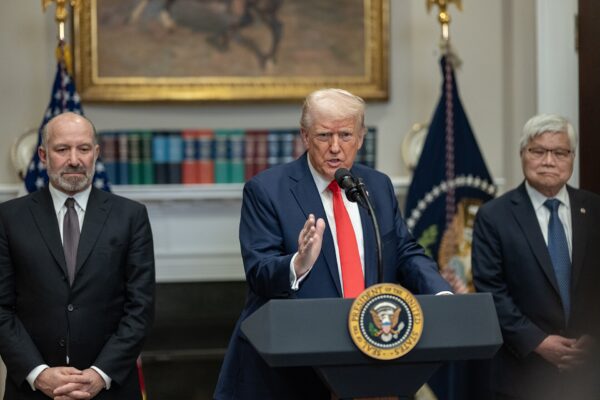
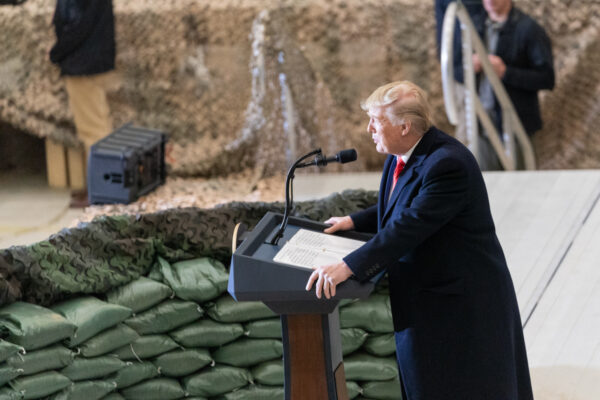
President Donald Trump on Friday made clear that his patience with Iran is wearing thin, declaring that regime change in Tehran “would be the best thing that could happen” as U.S. military power continues to surge into the region.
“For 47 years, they’ve been talking and talking and talking, and in the meantime, we’ve lost a lot of lives while they talk,” Trump said. “Legs blown off, arms blown off, faces blown off — this has been going on for a long time. So let’s see what happens. In the meantime … tremendous power has arrived and additional power — as you know, another carrier is going out.”
His remarks come amid a significant reassessment of Iran’s military posture following the recent 12-day conflict, which defense analysts say has altered the strategic landscape in ways that are both encouraging and alarming for U.S. policymakers.
According to senior officials at the Jewish Institute of National Security of America, Iran is emerging from the conflict weakened in certain respects but increasingly dangerous in others.
“The clocks have been reversed,” said Blaise Misztal, vice president for policy at JINSA, referring to the balance between the regime’s longevity and its nuclear breakout capability. He noted that Iran’s nuclear program is effectively “back to zero” following last year’s Operation Midnight Hammer, which destroyed three key nuclear enrichment facilities.
Instead of rushing to rebuild those nuclear capabilities, analysts say Tehran has redirected its efforts toward systems that proved effective during the recent fighting — particularly ballistic missiles.
“Iran’s ballistic missile program has gone leaps and bounds in both quality and quantity,” said Ari Cicurel, associate director of foreign policy at JINSA. He said Iran began the 12-day war with roughly 2,500 medium-range ballistic missiles and has already replenished its stockpile to about 2,000. That figure does not include what he described as thousands of short-range ballistic missiles also in Iran’s arsenal. Cicurel added that Iran is acquiring fuel mixtures from China to support its missile development.
U.S. defense planners are also increasingly concerned about Iran’s evolving battlefield doctrine. Rather than relying on single-system attacks, Tehran has adopted mixed bombardment tactics designed to overwhelm air and missile defenses. These strikes combine suicide drones, short-range missiles and medium-range ballistic missile barrages to confuse radar systems, exhaust interceptor supplies and complicate defensive targeting decisions.
That strategy appeared to gain traction near the end of the conflict. According to JINSA estimates, the United States expended roughly 150 Terminal High Altitude Area Defense interceptors during the fighting — about 25% of the American stockpile.
“That represents about 25% of the American stockpile,” said Jonathan Ruhe, a fellow for American strategy at JINSA. “It could take 18 months to replenish that.” He noted that War Secretary Pete Hegseth has pressed manufacturers to increase production, while cautioning that industrial ramp-ups require time.
Taken together, the assessments present a complicated reality. Iran’s nuclear ambitions may have been set back significantly, but its conventional missile capabilities are rebounding rapidly — potentially faster than Western defenses can be restocked.
Iranian officials, however, are publicly striking a different tone. In an interview aired Tuesday on PBS NewsHour, Iranian Foreign Ministry spokesman Esmaeil Baghaei rejected claims that Tehran is driving the confrontation.
“No human person of common sense welcomes war. No one wants war,” Baghaei said, describing what he called 47 years of unlawful and unjustified threats. He framed Iran’s resistance as a matter of national survival and argued that distrust between Washington and Tehran stems from what he characterized as unlawful U.S. actions.
The sharp divide between American analysts and Iranian officials underscores the central dilemma now facing Washington. While Tehran speaks of diplomacy and restraint, it is simultaneously rebuilding and refining the tools of coercion. Trump’s comments suggest growing skepticism about Iran’s intentions — and a readiness to back words with force if necessary.
Whether Iran’s public calls for negotiation reflect genuine openness or merely a strategic pause remains the unresolved question looming over U.S. policy in the region.
[READ MORE: White House Blames Democrats as DHS Shutdown Looms]