
As Democrats search for opportunities to expand their Senate map in 2026, one of the party’s most promising recruits is facing uncomfortable questions about his past — and renewed accusations that political expediency often outweighs principle.
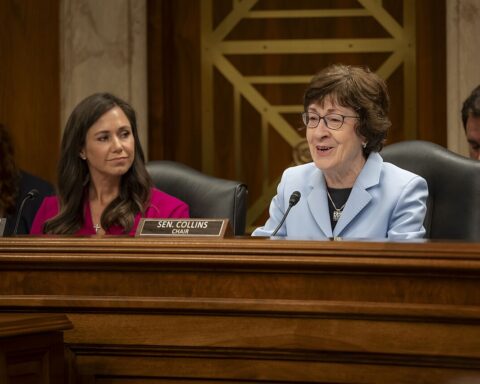
The controversy surrounding Graham Platner, the presumptive Democratic nominee challenging Republican Sen. Susan Collins in Maine, took center stage this weekend after CNN host Michael Smerconish devoted a segment of his program to what he described as a persistent blind spot within the Democratic Party.
Smerconish argued that Democrats have become increasingly willing to overlook troubling conduct from candidates whose primary qualification is opposition to President Donald Trump. As evidence, he pointed to Platner’s history, including a tattoo linked to Nazi imagery and a series of recently surfaced online comments that critics say raise concerns about the candidate’s judgment.
At the heart of the debate is a skull-and-crossbones tattoo that closely resembled the Totenkopf, a symbol historically associated with Nazi military units. Platner has acknowledged obtaining the tattoo in 2007 while serving overseas, saying he was intoxicated at the time and selected the image without understanding its historical significance.
The candidate has since covered the tattoo and repeatedly stated that he never intended to embrace or promote extremist ideology. Yet critics argue that the explanation leaves important questions unanswered.
Smerconish focused less on the circumstances surrounding the tattoo’s origin than on its longevity. The tattoo remained visible for nearly two decades before being covered in late 2025, shortly after Platner emerged as a serious Senate contender.
“Eighteen years of getting out of the shower, eighteen years looking into the mirror and seeing the Totenkopf,” Smerconish said during his broadcast. “That’s not a drunken mistake. That’s a daily choice sustained for nearly two decades.”
The tattoo controversy comes alongside scrutiny over old Reddit posts attributed to Platner, including comments mocking a military veteran who appeared in footage from a combat situation overseas. The posts have added to concerns among critics who question whether Democrats are applying the same standards to Platner that they have demanded of Republicans.
Smerconish reserved particular criticism for prominent Democrats who have rallied behind the candidate despite the revelations. Among them is Sen. Elizabeth Warren of Massachusetts, who enthusiastically endorsed Platner and described him as an authentic voice for Democratic voters.
For conservatives, the episode highlights what they see as a recurring pattern in modern politics: behavior that would trigger widespread outrage if associated with a Republican candidate often receives a more forgiving assessment when attached to a Democrat viewed as politically valuable.
Smerconish noted that Warren previously attacked public figures over issues ranging from nondisclosure agreements to controversial tattoos, including raising concerns about the body art of Defense Secretary Pete Hegseth. Yet Platner’s Nazi-linked tattoo, online comments and past self-identification as a communist have not prevented him from receiving support from influential Democratic leaders.
The reason, critics contend, is straightforward. Democrats view Maine as one of their best opportunities to unseat a Republican incumbent, and Platner is seen as a candidate capable of putting Sen. Collins’ seat in play.
As the campaign intensifies, the controversy may test whether voters are willing to accept Platner’s explanations—or whether concerns about consistency, accountability and political double standards become a larger issue in one of the nation’s most closely watched Senate races.
[READ MORE: Arroyo Blasts Chicago Mayor’s Vatican Visit, Warns Against Using Pope for Political Messaging]