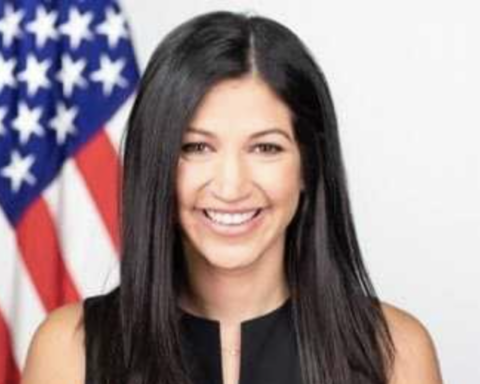
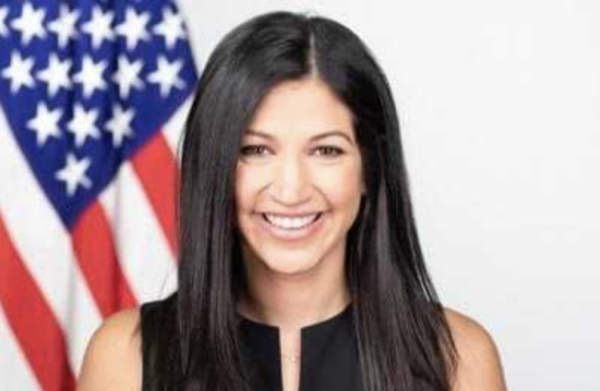
Katie Miller accused Politico of promoting “anti-American propaganda” Tuesday after the outlet published an opinion article criticizing the United States military’s record in recent wars.
Miller, the wife of longtime Trump adviser Stephen Miller, took aim at the Washington-based political news outlet in a post on X after an op-ed argued that America possesses unmatched military power while failing to achieve lasting victories in war over the past three decades.
“Politico was purchased by the Germans,” Miller wrote. “This is anti-American propaganda pushed by a company once founded in DC.”
Her remarks referenced the 2021 acquisition of Politico by Axel Springer, the German publishing giant that purchased the outlet as part of a major international media expansion.
The article that triggered Miller’s response was written by Ivo Daalder, who served as U.S. ambassador to NATO under former President Barack Obama from 2009 to 2013. Daalder is now a senior fellow at Harvard University’s Belfer Center.
In the piece, Daalder argued that the ongoing conflict involving Iran represents another failed military entanglement in a long line of costly American wars overseas. He claimed the United States has repeatedly entered conflicts without clear political objectives or sustainable end goals.
“Since 1945, the U.S. has fought major wars in Korea, Vietnam, Afghanistan, Iraq and now Iran,” Daalder wrote. “Among them, only the 1991 Gulf War counts as a genuine success — and even that planted the seeds of future disaster.”
He continued by arguing that the outcomes of America’s modern wars have ranged “from stalemate and defeat to strategic catastrophe,” describing the Iran conflict as potentially “the worst strategic blunder the U.S. has made post-World War II.”
Daalder also criticized the broader culture surrounding foreign policy in Washington, arguing that leaders too often approach military action without clearly defined political outcomes. He singled out President Donald Trump as what he called the “most extreme expression” of that tendency.
According to Daalder, policymakers increasingly treat war “not as a continuation of policy but as the failure of policy — a last resort that is reached when diplomacy collapses, often with no set political outcome in mind.”
The op-ed appeared just days after Trump stated over the weekend that a peace agreement with Iran would “be announced shortly,” raising hopes among supporters that negotiations could soon bring an end to months of escalating tensions in the Middle East.
Miller’s reaction reflected growing frustration among many conservatives who view criticism of the U.S. military — particularly during active international conflicts — as undermining American strength and morale. At the same time, Daalder’s arguments tapped into a separate and increasingly vocal concern shared across parts of the political spectrum: whether decades of foreign intervention have delivered the strategic outcomes promised by leaders in Washington.
The clash also highlighted the widening divide over how Americans interpret military power in the post-9/11 era. For some, questioning the success of past wars risks diminishing the sacrifices made by service members. For others, repeated conflicts with uncertain outcomes have fueled skepticism toward open-ended military engagements and the political establishment that oversees them.
As debate continues over Iran, diplomacy, and America’s role abroad, the exchange between Miller and Politico underscored how discussions about national strength are increasingly colliding with deeper questions about the costs, goals, and consequences of modern warfare.
[READ MORE: CNBC Host Warns Market Crash Is Inevitable Amid Growing Fear In Corporate America]