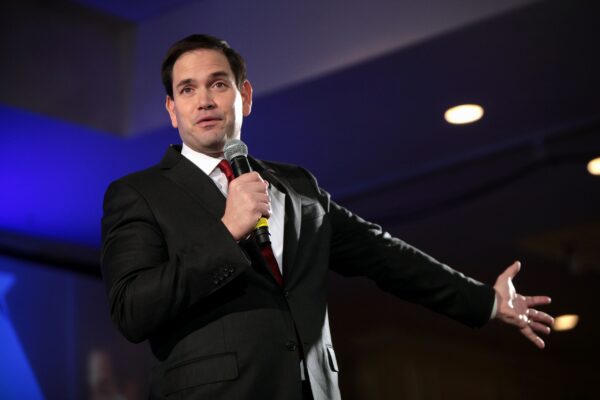
Secretary of State Marco Rubio told lawmakers Tuesday that Iran’s Supreme Leader, Mojtaba Khamenei, appears to be playing an increasingly active role in negotiations between Washington and Tehran as diplomatic efforts continue amid the ongoing war.
Appearing before the Senate Foreign Relations Committee in his first public testimony since the conflict began, Rubio offered lawmakers an update on the state of communications between the United States and Iran, describing a negotiation process that remains slow and heavily dependent on intermediaries.
“We haven’t seen him publicly,” Rubio said of Khamenei. “And I would imagine given what’s happened to multiple leaders in that system, being very public is probably not something that’s recommended for them internally.”
While noting the Iranian leader’s limited public profile, Rubio suggested there are signs that Khamenei has become more directly involved behind the scenes.
“But that said, I think there are indications out there that he is increasingly engaging at some level,” Rubio told senators. “Although all of his communications have been in writing and through intermediaries.”
The secretary’s comments come at a delicate moment in negotiations. Reports have indicated that Iran has withdrawn from discussions aimed at extending the current ceasefire, accusing the United States of violating the agreement’s conditions because of Israel’s continuing military campaign in Lebanon.
That development has cast additional uncertainty over already fragile diplomatic efforts, with both sides continuing to exchange messages through third parties rather than direct talks.
Rubio explained that the process of communication remains slow and cumbersome, saying it can take days to receive a response from Tehran regarding proposals or conditions under consideration.
Despite those obstacles, the secretary pointed to what he described as meaningful movement on one of the most important issues facing negotiators: Iran’s nuclear program.
According to Rubio, Iranian officials have shown a greater willingness to discuss aspects of their nuclear activities than they had in the past.
“They have agreed to negotiate aspects of their nuclear program that just a month ago, just a year ago, they were refusing to even mention,” Rubio said.
Still, he cautioned lawmakers against assuming that progress at the negotiating table guarantees a final agreement.
“There’s no guarantee it will lead to a deal that’s acceptable,” he added.
The Trump administration has maintained a firm position throughout the talks, insisting that Iran cannot possess a nuclear weapon either now or at any point in the future. Administration officials have also sought concessions involving Iran’s stockpile of enriched uranium, making the issue a central focus of ongoing negotiations.
While diplomacy continues, pressure has mounted from international leaders who are urging both sides to find common ground and reach an agreement in the near term. Those calls have been driven in part by concerns over the Strait of Hormuz, a vital waterway whose reopening is widely viewed as important for broader economic and market stability.
The continuing conflict and uncertainty surrounding negotiations have heightened the stakes of the talks. As military tensions persist, diplomats are attempting to secure an outcome that could reduce instability and prevent the conflict from expanding further.
For his part, President Donald Trump has sought to project confidence despite criticism from some observers who want a faster resolution.
On Monday, the president addressed those concerns directly in a Truth Social post.
“Just sit back and relax, it will all work out well in the end – It always does!” Trump wrote, while also telling critics to stop “chirping” and pressuring him into an agreement.
For now, negotiations remain ongoing, with both sides continuing to communicate through intermediaries as officials work toward an outcome that remains uncertain but increasingly consequential.