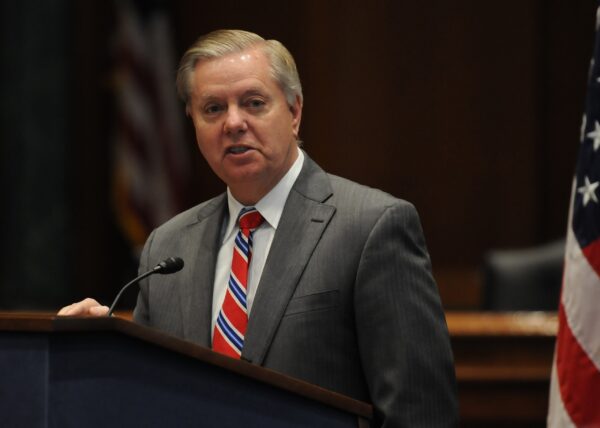
The ongoing conflict with Iran has emerged as a central issue in South Carolina’s Republican Senate primary, placing Sen. Lindsey Graham’s long-established foreign policy views under renewed scrutiny as he seeks another term in office.
Graham, a close ally of President Donald Trump and one of the Senate’s most outspoken advocates of a muscular foreign policy, remains the clear favorite to secure the Republican nomination. However, recent polling suggests the four-term senator could be forced into a runoff election, something he has never faced before in his political career.
The challenge comes as divisions within the Republican base continue to grow over America’s role in overseas conflicts and the economic consequences associated with prolonged military engagements.
Leading the opposition to Graham is Mark Lynch, an appliance repair executive who has positioned himself as a more firmly “America First” alternative. Lynch has criticized Graham’s support for foreign aid, interventionist policies, and visa programs, arguing that such positions place international concerns ahead of the interests of American workers and taxpayers.
His campaign has sought to capitalize on increasing dissatisfaction among some Republican voters who question continued involvement in foreign conflicts and are concerned about the financial impact of the war.
To avoid a runoff election, Graham must secure more than 50 percent of the vote in the June 23 primary.
Recent polling paints a mixed picture of the race. An InsiderAdvantage survey released Monday found Graham narrowly above the threshold, receiving 51.2 percent support among Republican primary voters. Lynch drew 20.9 percent, while 18.4 percent remained undecided and 9.5 percent backed another candidate.
A separate poll conducted by the Citadel School of Humanities and Social Sciences showed a much tighter contest. That survey found Graham with 46 percent support, Lynch with 36 percent, and 18 percent of voters still undecided.
The numbers stand in sharp contrast to Graham’s last primary victory in 2020, when he captured nearly 68 percent of the vote.
President Trump entered the race on Graham’s behalf Monday evening during a tele-rally, where he highlighted both the senator’s loyalty and his support for the administration’s approach to the conflict.
“You’re really going to win it over the next two weeks, when we declare total victory,” Trump said while discussing the war.
“Lindsey has been fighting with me all the way,” the president added.
Graham has been among the strongest supporters of the military campaign and has publicly urged South Carolinians to prepare for the possibility that American service members could be called upon in the region.
While campaigning, Graham acknowledged that inflation and fuel prices remain major concerns for voters. Even so, he maintained that the intervention was necessary despite the economic consequences.
“The only answer I know to give you is an honest one,” Graham told WYFF News 4. “They’ll come down when this war winds down, and we’re inside the 10-yard line.”
“But President Trump had to do this in my view,” Graham continued. “Whatever cost we paid — and it’s been consequential — it’s better than allowing Iran to get nuclear weapons to destroy Israel, and one day come after us.”
The primary campaign unfolds against the backdrop of renewed instability in the Middle East. Over the weekend, Iran and Israel exchanged fire for the first time since an early-April ceasefire took effect. Although both sides later indicated that the attacks had stopped, the exchange exposed the fragility of the truce and highlighted the uncertainty surrounding the broader conflict.
At the same time, despite Trump’s public optimism that a diplomatic agreement may be close, the war has now surpassed the 100-day mark. As the conflict continues with no clear conclusion, political pressure has increased on both the administration and its allies, particularly as public support for the war appears to be weakening.