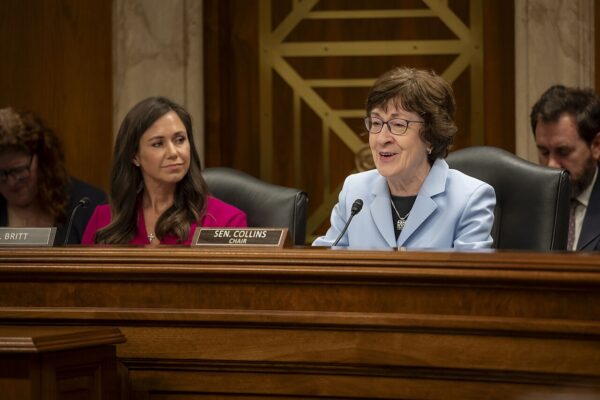
Republican Sen. Susan Collins of Maine reportedly said former Rep. Liz Cheney, R-Wyo., has “no impact” in today’s political arena after losing her congressional seat and breaking sharply with President Donald Trump.
Collins made the blunt assessment during a wide-ranging interview with Politico reporter Jonathan Martin published Wednesday.
Martin asked Collins whether she fit into one of two Republican archetypes: lawmakers like Cheney who openly stand up to Trump, or lawmakers like the late Sen. Lindsey Graham, R-S.C., who sought to maintain influence by cultivating a close relationship with the president.
The Maine Republican rejected both characterizations.
“With the case of Liz Cheney, what influence does she have today? Really none,” Collins said.
Collins is currently facing a difficult reelection fight against Democratic challenger Troy Jackson in Maine.
Cheney, who previously chaired the House Republican Conference, generally supported Trump’s agenda during his first term. However, her relationship with the president collapsed following the Jan. 6, 2021, attack on the U.S. Capitol.
Trump later endorsed Cheney’s Republican primary opponent, Harriet Hageman, in Wyoming’s 2022 congressional race. Hageman defeated Cheney by nearly 40 points before going on to serve in the House.
Since leaving Congress, Cheney has continued promoting traditional conservative positions while remaining a fierce critic of Trump. She also crossed party lines during the 2024 presidential election by campaigning for former Vice President Kamala Harris.
Collins argued that Cheney’s political shift, combined with the loss of her House seat, left her with little ability to influence the national conversation.
“Liz Cheney, it’s not just that she lost her seat, it’s that she has no impact, in my view,” Collins told Martin.
Still, Collins said Cheney’s work on the House committee that investigated the events surrounding Jan. 6 deserved respect.
“You can respect the work that she did on the Jan. 6 commission,” Collins said.
The Maine senator also defended her own decision to vote to convict Trump during his second impeachment trial. Collins said her conclusion was based on the evidence presented and her personal experience at the Capitol on Jan. 6.
“After listening to the evidence and being there on Jan. 6 myself, I felt that the president had, many months before, started to build up an insurrection, essentially,” Collins said.
She argued that Trump’s conduct leading up to the Capitol attack satisfied the “high standard of his removal” from office.
Cheney reached a similar conclusion and became one of only 10 House Republicans who voted to impeach Trump following the attack.
Collins acknowledged that her conviction vote continues to come up during her interactions with the president, saying Trump has clearly not moved past it.
“Believe me, the president brings up that vote almost every single time that I see him,” Collins said. “So, he has not forgotten.”