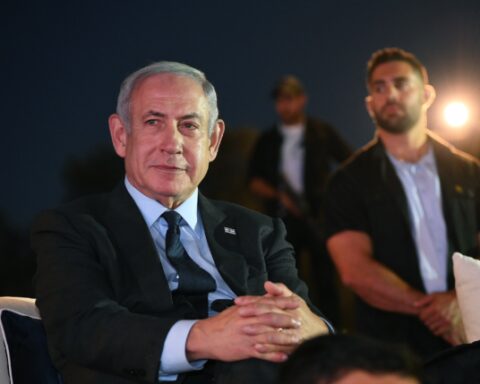
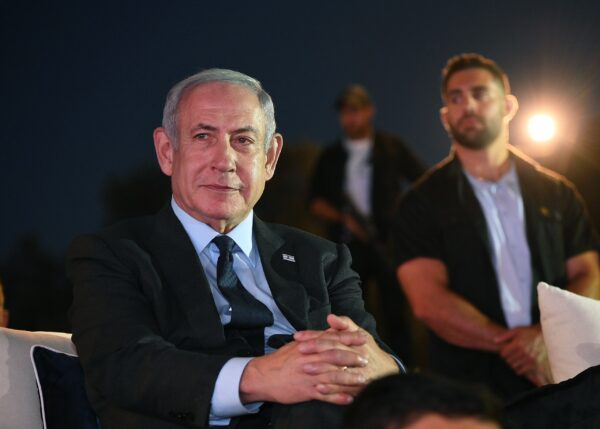
Israeli Prime Minister Benjamin Netanyahu said Thursday that defeating Iran’s regime may ultimately require more than airstrikes, raising the prospect of a “ground component” as the U.S.-Israeli conflict approaches its fourth week.
Speaking at a press conference in Jerusalem, Netanyahu acknowledged the limits of air power alone. “It is often said that you can’t win –– you can’t do revolutions from the air, that is true,” he said. While emphasizing that Israel has achieved significant results through aerial operations, he made clear that a broader strategy could be necessary. “There has to be a ground component, as well,” he added, declining to provide details on how such an effort might unfold.
Netanyahu framed the situation as one that ultimately depends on the Iranian people. He argued that while Israel and the United States can create conditions for change, it would be up to Iranians themselves to act. At the same time, he cautioned against simply replacing one form of authoritarian rule with another, saying, “You don’t want to replace one ayatollah with another… You don’t want to replace Hitler with Hitler.”
The prime minister also claimed that Iran’s ability to enrich uranium and produce ballistic missiles has been severely degraded, stating that Israeli operations would continue in order to “crush these capabilities to the core.” Those remarks signal a continued commitment to military pressure, even as questions grow about how far the campaign may extend.
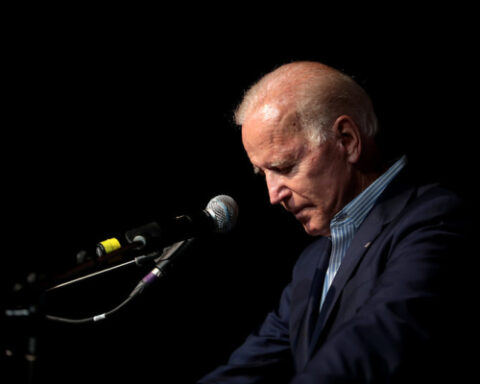
The suggestion of a possible ground element comes amid mixed signals from Washington. President Donald Trump said Thursday that he is not planning to deploy U.S. troops “anywhere,” though earlier reporting indicated the administration has considered sending thousands of troops to bolster operations in the region. That contrast highlights a delicate balance between projecting strength and avoiding deeper entanglement.
Analysts have noted that Israel and the United States may not be fully aligned in their objectives. According to The New York Times, Israel has placed greater emphasis on regime change, while the Trump administration has focused more narrowly on dismantling Iran’s military capabilities. Former U.S. negotiator Aaron David Miller suggested those differing priorities could eventually come into conflict, particularly if Washington seeks to wind down the operation while Israel pushes forward.
Recent events have added to the uncertainty. Netanyahu said Israel acted alone in striking Iran’s South Pars gas field, the country’s largest gas complex, which it shares with Qatar. President Trump initially said he did not approve of the strike and that the U.S. had no prior knowledge, later adding that he had warned against it. However, multiple Israeli officials told The New York Times the operation had been coordinated in advance with the U.S., underscoring the murky nature of coordination between the allies.
Meanwhile, the rationale for the conflict continues to be debated. Trump has described Iran as posing an “imminent nuclear threat,” though Director of National Intelligence Tulsi Gabbard previously indicated otherwise in written remarks. During a congressional hearing, Gabbard acknowledged that the U.S. and Israel are pursuing different objectives, with Israel focused on weakening Iran’s leadership and the U.S. targeting its missile and naval capabilities.
Public opinion appears skeptical about where the conflict may lead. A Reuters/Ipsos poll released Thursday found that 65 percent of Americans believe Trump will eventually order a large-scale ground invasion, even as the president insists he will not. Just 7 percent support such a move.
As the war enters its next phase, Netanyahu’s comments point to a possible escalation that could test both political will and public tolerance. While leaders speak in terms of strategy and objectives, the discussion of ground involvement serves as a reminder that even conflicts launched with limited aims can carry the risk of expanding far beyond their original scope.
[READ MORE: Pentagon Bars Stars and Stripes from Briefing, Stirring Debate Over Access and Independence]