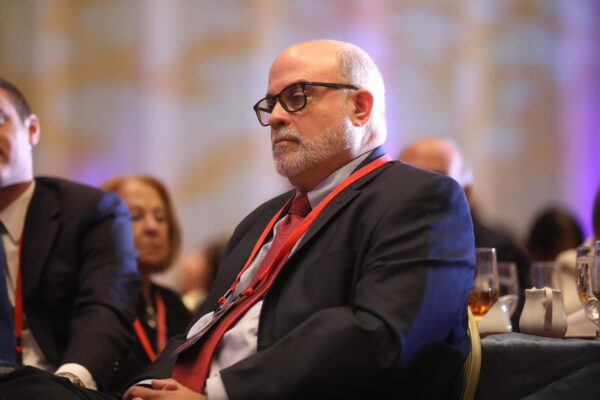
Fox News host Mark Levin intensified his criticism of President Donald Trump’s memorandum of understanding with Iran on Saturday, arguing that the agreement risks rewarding a regime he believes remains fundamentally hostile to the United States and its allies.
During a lengthy and passionate segment on Saturday’s edition of Life, Liberty & Levin, the conservative commentator took aim at what he described as efforts by “people in and out of the administration” to pressure Israel while portraying Iran in a more favorable light.
Levin opened his remarks by expressing frustration over what he sees as a growing willingness to soften attitudes toward Tehran at a time when, in his view, the regime has done little to earn that trust.
“I’m going to start the program where I’d rather not start, but I must,” Levin said. “I want to say to people in and out of the administration, stop trashing, smearing, bullying the little state of Israel. Stop cozying up to and telling us that the enemy regime in Iran is now more rational, more moderate, and a regime that we can deal with.”
While Levin did not directly criticize Trump by name during that portion of the commentary, his remarks came after the president recently described Iranian negotiators as “very rational” and “nice to deal with.”
Levin contrasted the current debate with the close military cooperation between the United States and Israel during the conflict with Iran and its proxies. He said he was troubled by what he viewed as a shift away from that partnership.
“I think it’s outrageous,” Levin said, recalling discussions on Fox News about the strong coordination between the two nations’ militaries. He added that he hoped the current rhetoric would come to an end, arguing that it was neither fair nor truthful.
The host then turned to specific provisions in the memorandum of understanding, focusing heavily on language calling for the immediate and permanent end of military operations on all fronts, including against Hezbollah.
Levin described that provision as a serious mistake, arguing that Hezbollah remains a central instrument of Iranian influence in the region. He contended that halting military action against the group benefits Tehran while leaving Israel to contend with an adversary that continues to threaten its security.
According to Levin, the provision represents an unnecessary concession that weakens pressure on a key Iranian ally. He repeatedly questioned why such a measure would be included when Hezbollah remains deeply tied to the Iranian regime.
Later in the broadcast, Levin shifted his attention to the economic aspects of the agreement, particularly the lifting of sanctions on Iran. He questioned why a regime that had been weakened through military and economic pressure would now be granted significant relief.
Levin argued that supporters of the agreement have celebrated Iran’s setbacks while simultaneously embracing policies that could help the regime recover. In his view, those positions are difficult to reconcile.
Despite his broader support for defeating hostile regimes, Levin’s criticism reflected a concern shared by many foreign policy hawks: that military victories can be undermined if their political outcomes ultimately strengthen the same governments they were meant to weaken.
He concluded with a stark warning, saying he does not believe Iran will ultimately honor the terms of any agreement. Levin argued that the regime’s ideological commitments remain unchanged and predicted that Tehran would use any benefits gained from the deal to rebuild its strength before eventually challenging its adversaries once again.
For Levin, the central issue is not the wording of the agreement itself but whether a regime he views as fundamentally committed to its revolutionary mission can ever be trusted to uphold it.