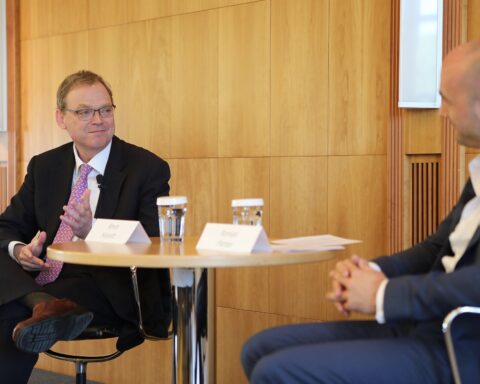

Barclays CEO C.S. Venkatakrishnan called artificial intelligence the “icing on the cake” Thursday as the British banking giant announced plans to eliminate roughly 5,000 jobs by the end of the year.
The cuts amount to approximately 5% of Barclays’ global workforce. According to the bank, 1,000 positions have already been eliminated, with another 4,000 expected to be cut before the end of 2026.
The announcement came alongside the bank’s third-quarter financial results, which showed pretax profits rising 12% to approximately $3.1 billion. Even with those gains, executives laid out plans for further cost reductions tied to technological modernization.
Venkatakrishnan described the role AI is playing in the bank’s restructuring, stressing that the technology builds on deeper investments the company has already made.
“I’ve often said that it is the icing on the cake – it’s not the cake – because you need to do the infrastructure build to get the benefits of AI,” Venkatakrishnan said.
The Barclays chief emphasized that AI was not solely responsible for the workforce reductions. Instead, he attributed much of the company’s efficiency gains to years of investment in modernizing its systems and simplifying its business operations.
Still, the technology is set to play a significant part in reshaping the bank’s workforce. Roughly 60% of the job cuts will hit support functions, including software developers, as AI enables remaining employees to handle more work, according to Reuters.
Barclays expects its cost-cutting push to deliver approximately $1.5 billion in additional savings in 2027.
The bank also announced a £500 million share buyback program. That brings Barclays’ shareholder distributions so far this year to £2.8 billion.
The layoffs arrive as major corporations increasingly turn to automation to reduce labor costs, a trend that is raising concerns about the future of jobs traditionally performed by human workers.
Barclays is not alone in looking to AI to reshape its workforce. In a related development, BMW recently announced it is replacing several management roles with AI.
Within the banking industry, the adoption of AI has drawn warnings from labor representatives. They argue that companies should focus on retraining employees rather than eliminating their positions outright.
Sharon Graham, general secretary of the Unite union, sharply criticized the bank’s move. According to the BBC, Graham accused Barclays of “using AI as an excuse to discard its loyal and long-suffering workforce.”
The criticism highlights the growing tension between corporate efficiency goals and the concerns of workers whose roles may be affected as AI becomes more deeply embedded in day-to-day operations.
For Barclays, the strategy pairs strong quarterly profits with an aggressive cost-cutting agenda. The bank is betting that years of infrastructure investment, now combined with AI, will allow it to do more with fewer employees.
Venkatakrishnan, for his part, maintains that AI is the finishing touch rather than the foundation, with the real work having come from modernizing the bank’s systems and streamlining how it does business.
As the cuts continue through the end of 2026, the move is likely to remain at the center of the broader debate over how AI will reshape the workforce across major industries.