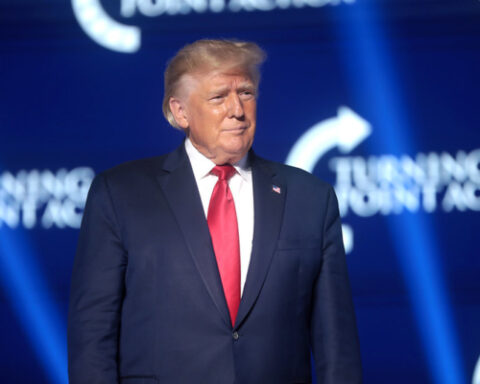
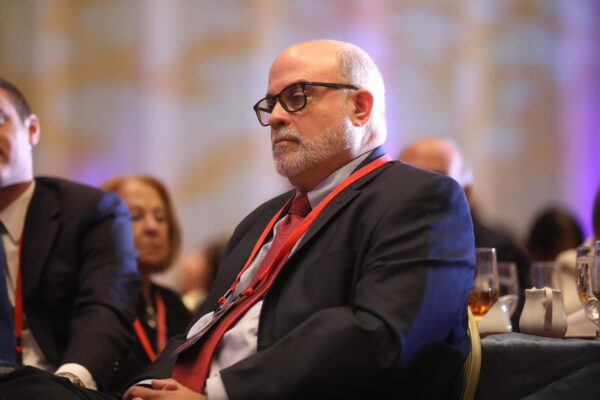
Mark Levin reportedly used his Saturday night program to lay out a forceful argument for deploying specialized U.S. troops into Iran, as President Donald Trump continues to weigh military and diplomatic options in the region.
Speaking on his show Life, Liberty & Levin, the longtime conservative commentator pushed back on criticism that sending “boots on the ground” would contradict Trump’s 2024 campaign posture. Levin dismissed those claims outright, saying he does not recall Trump making such a pledge during the campaign.
Instead, Levin framed the issue as one of urgency and national security, pointing to Iran’s uranium stockpile as the central concern. According to Levin, the material poses a serious threat if left unsecured, warning it could be used in so-called “dirty bombs” or missile development.
“We’ve got to get the uranium,” Levin said during the broadcast. “If it cannot be destroyed, if it cannot be altered, we gotta get it.”
Levin emphasized that he is not advocating for a large-scale ground war, drawing a distinction between traditional invasions and more limited, strategic deployments. He suggested that a relatively small number of highly trained troops — such as elements of the Army’s 82nd Airborne Division — could be sufficient for a targeted mission focused on securing nuclear materials.
“He’s not talking about sending regular Army infantry in by the hundreds of thousands,” Levin said, referring to Trump. “The men he’s talking about, the units he’s talking about, they are specialized.”
Levin added that, based on his experience during the Reagan administration, such units are specifically trained for high-stakes operations involving sensitive materials like enriched uranium.
The comments came shortly after Trump himself encouraged viewers to tune into Levin’s program, highlighting an interview with Marc Thiessen, a Washington Post columnist and Fox News contributor.
In that interview, Thiessen echoed Levin’s concerns, arguing that Iran could retaliate indirectly by transferring uranium to terrorist groups such as Al Qaeda. He described that scenario as the “easiest way” for Iran to strike back at the United States following military action, raising fears about the potential for attacks using transferred materials.
The discussion underscores the difficult balancing act facing the Trump administration. On one hand, Trump has said the U.S. and Iran recently held “very, very strong talks” about ending the conflict. On the other, the administration has continued to build up military presence in the region, including the deployment of 3,500 Marines and consideration of sending as many as 10,000 additional troops.
Levin closed his opening monologue by expressing confidence in Trump’s leadership, calling him a figure of “enormous intelligence” and common sense. Still, the broader debate reflects a familiar tension in American foreign policy: how to confront emerging threats without becoming entangled in another prolonged conflict.
While Levin and Thiessen argue that a limited, specialized mission could neutralize a key danger, even narrowly defined military actions carry risks — particularly in a region already marked by volatility. As the operation enters its second month, the question remains whether a targeted intervention would achieve its objectives quickly, or open the door to deeper involvement.
For now, Trump appears to be keeping multiple options on the table, navigating between diplomacy and escalation as pressure mounts to act decisively while avoiding the costs of a wider war.